
|
Home | ||
Junagarh Fort |
|
 Built in 1593 A.D. by Raja Rai Singh(1571-1611 A.D.), a general in the army of emperor Akbar, the fort is a formidable structure encircled by a moat and has some beautiful places within.
These places, made in red sandstone (Dulmera) and marble, make a picturesque ensemble of countryards, balconies, kiosks and windows dotted all over the structure. The imposing fort has 986 long wall with 37 bastions and two entrances. It is approached through the Karan Poal which is the main entrance. Among the places of interest are Anop mahal, Ganga niwas and Rang mahal or palace of pleasure. |
|
Lallgarh Palace |
Top^ |
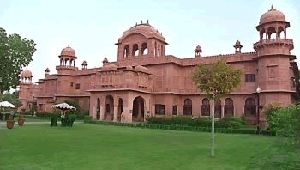 The architectural masterpiece in red sandstone, the palace was built by Maharaja Ganga Singh (1881-1942 A.D.) in the memory of his father Maharaja Lal Singhji in 1902 AD. The palace has beautiful latticework and filigree work. Sprawling lawns with blooming bougainvillea and dancing peacocks make it to be a not -to-be missed visual treat.
This oriental fantasy Designed by Col. Sir Swinton Jacob, is entirely a hybrid architecture -a mixture of different elements of Rajput, Muslim and European styles and can be categorized as Indo-Seresanic style. The Rajput exterior of this palace contrasts dramatically with the occidental decor within. The intricately dexterous carving on red sandstone is a hallmark of great craftsmanship. |
|
Gajner Palace |
Top^ |
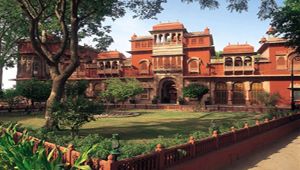 The Gajner Palace was built by Maharaja Ganga Singhji of Bikaner in the early 20th century. Sprawled over a vast area of 6000 acres, this grand palace is located on the banks of the Gajner Lake. The Gajner Palace in Bikaner was originally built as a hunting resort for the royals and visiting British dignitaries.
 Many a times, the Gajner Palace was the venue for grand shoots and parties that always added up as lavish affairs. Right from Viceroys to royal guests, the Gajner Palace has played a proud host to many famous names in history. One of the most impressive features of the Gajner Palace is its delightful red sandstone façade that adds to its old worldly elegance. Besides, the lush greenery surrounding this beautiful palace also makes it a wonderful sight to marvel at. |
|
Karni Mata Temple (Rats temple) |
Top^ |
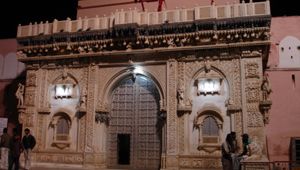 The Karni Mata temple, Deshnok is situated 30 km from Bikaner. The temple is dedicated to an early 15th century mystic, considered to be a reincarnation of Goddess Durga. This temple is quite famous for a large number of brown rats running around the temple complex fearlessly. It is believed that the souls of dead Charans (traditional bards, the devotees of Mata) reside in these rats. The Karni Mata temple, Deshnok is situated 30 km from Bikaner. The temple is dedicated to an early 15th century mystic, considered to be a reincarnation of Goddess Durga. This temple is quite famous for a large number of brown rats running around the temple complex fearlessly. It is believed that the souls of dead Charans (traditional bards, the devotees of Mata) reside in these rats. It is considered very lucky seeing a white rat or when a rat runs over your foot.During the time of aarti, these rats are offered sweets, grains, etc by the devotees.The thing which strikes everyone with wonder is the presence of thousands and thousands of rats in the temple which freely moved about unscared of anyone Despite the presence of the pilgrims in great numbers. At no time in the past plague broke out here. There was no incidence of plague at all. People deem this as an miracle of Karanimata. In the whole world this is a unique temple where rats freely move out. |
|
Bhandeshwar and Sandeshwar Temples |
Top^ |
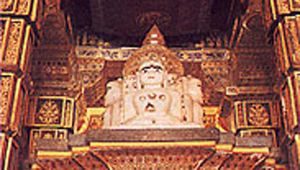 These Jain temples were built by two brothers and named after them-the Bhandeshwar temple-rich in mirror work and the Sandeshwar temple-stylized enamel and gold leaf wall paintings. The temples are dedicated to 23rd Jain teerthankar, Parsvanathji. These Jain temples were built by two brothers and named after them-the Bhandeshwar temple-rich in mirror work and the Sandeshwar temple-stylized enamel and gold leaf wall paintings. The temples are dedicated to 23rd Jain teerthankar, Parsvanathji. Bhandeshwar Temple is exquisitely decorated with intricate glasswork and frescoes, while at Sandeshwar Temple you will find gold enameled wall paintings. |
|
Shiv Bari Temple |
Top^ |
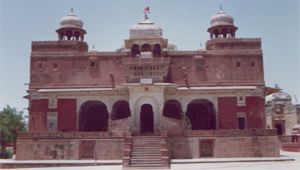 Shiv Bari Temple is approximately 6 kms from the main city. Maharaja Doongar Singhji built this magnificent temple. Major highlights of Shiv Bari Temple are domes, pavilions and beautiful columns. Local inhabitants refer Shiv Bari Temple by the name of Laleshwar Mahadeo. This temple features a huge idol of Lord Shiva made up of black marble.
The splendid Shiv Bari Temple is made up of red sand stone. Experience the magic of Shiv Bari Temple by planning stay at hotels in Bikaner. Bikaner offers varied ranges of hotels. You would be provided from luxury hotels to cheap hotels. |
|
Bhaironji Temple |
Top^ |
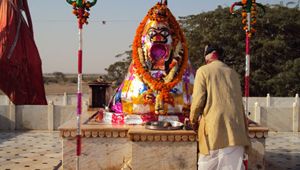 The Bhairon Vilas Palace hotel in Bikaner is one of the best examples of Rajput architecture. Built in the year 1872, it was also the personal residence of Maharaja Bhairon Singh Ji. Bhairon Vilas in Bikaner has always been in the news for the Bhairon temple. This Haveli has already been a landmark because many dignitaries have visited this wonderful work of art. Almost all the Viceroys and Governor Generals of India have visited this place.
 |
|
Ganga Singh Museum |
Top^ |
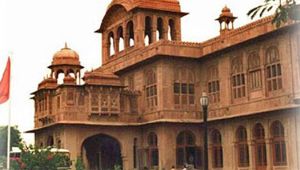 Established near the Lalgarh Palace in Bikaner in 1937 on the eve of the Golden jubilee celebrations of Maharaja Ganga Singh, this Museum now run by the Government of Rajasthan, was shifted to a new building in the Civil lines in 1954It is the best Rajasthan museum, having one of the richest collection of Terracotta ware, weapons, maniature paintings of Bikaner school and coins. The exhibits are splendid master pieces of Harappan civilisation, Gupta and Kushan era and sculptures of the late classical time.
 |
|
Sun Gate |
Top^ |
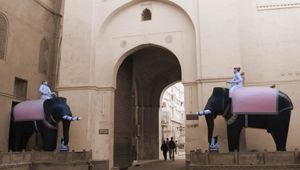 Suraj Pol or Sun Gate is the main entrance to the Junagarh Fort. The fort is encircled by a moat that protects the splendid complex of thirty-seven palaces, pavilions and temples added by different rulers, the last one, as recently as 1943. Their lavishly adorned interiors are much better preserved than those in any other palace in the region. Suraj Pol or Sun Gate is the main entrance to the Junagarh Fort. The fort is encircled by a moat that protects the splendid complex of thirty-seven palaces, pavilions and temples added by different rulers, the last one, as recently as 1943. Their lavishly adorned interiors are much better preserved than those in any other palace in the region. |
|
Kalibangan |
Top^ |
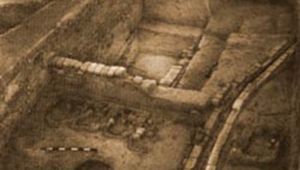 Situated 205 kms from the city of Bikaner, is the small town of Kalibanga, which is located in Hanumangarh district. The remnants of the pre-Harappan and Harappan settlements have been found at this place. A site of delight for the archaeology enthusiasts, its Archaeology date back to the Harappan and pre-Harappan times.
Archaeology at Kalibanga reveal that Rajasthan had been an important centre of the ceramic industry. The paintings on the ancient pottery from Kalibanga bear close affinity and resemblance with the Harappan designs. The contemporary potters of Rajasthan were fully aware of the Indus Valley ceramic handicrafts and industry. |
|
Shri Sadul Museum |
Top^ |
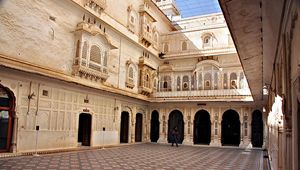 Shri Sadul Museum is located at Lalgarh Palace, the red sandstone palace located in Bikaner. It is housed in the Ganga Niwas, which covers the entire first floor of the palace. Shri Sadul Museum is located at Lalgarh Palace, the red sandstone palace located in Bikaner. It is housed in the Ganga Niwas, which covers the entire first floor of the palace.The museum displays a unique collection of miniature paintings, manuscripts, weaponry and old photos depicting royal hunts. It also houses the personal possessions of former Bikaner rulers, which includes golf tees, camera, clothes, books and earplugs. The museum is open daily from 10:00 to 17:00 hrs, except on Wednesdays. It can be visited on a small entrance fee. Photography is not allowed. Shri Sadul Museum is about 3 km from Bikaner Junction Railway Station and 2 km north of downtown area. |
|
The Rajasthan State Archives |
Top^ |
 This Directorate is located in Bikaner. The archives have in their custody some very precious administrative record of Mughal period like Persian Farmans, Nishans, Manshurs, Akbarat, Vakil Report, Arzdasht, Khatoot and the record created during administration of the Princely states of Rajasthan such as Bahiat, Pattas, Parwanas, Rukkas, Chithiat etc.
Because of this exceptional collection of records the department is of immense value to researchers all over the world. Facilities like microfilming, reference library and research rooms are also available to researchers. An exhibition of important documents is also set-up specially for tourist interest. This Directorate is located in Bikaner. The archives have in their custody some very precious administrative record of Mughal period like Persian Farmans, Nishans, Manshurs, Akbarat, Vakil Report, Arzdasht, Khatoot and the record created during administration of the Princely states of Rajasthan such as Bahiat, Pattas, Parwanas, Rukkas, Chithiat etc.
Because of this exceptional collection of records the department is of immense value to researchers all over the world. Facilities like microfilming, reference library and research rooms are also available to researchers. An exhibition of important documents is also set-up specially for tourist interest.
|
|
Katariasar Village |
Top^ |
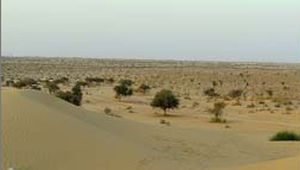 It is located 50 kilometres from Bikaner. It is a temple complex of Kolyat and a holy place of pilgrimage for Hindus. The legend has it that Kapil Muni the advocate of Shankya yoga of the Hindu philosophy while journeying towards northwest was struck by the tranquility and peace of this place and chose to perform tapasya (penance) here for the redemption of the world. This place has since acquired great sanctity. The complex has several temples, pavilions and bathing ghats. A dip in the holy waters of the lake especially on Kartik Poornima (November) is considered very auspicious. It is located 50 kilometres from Bikaner. It is a temple complex of Kolyat and a holy place of pilgrimage for Hindus. The legend has it that Kapil Muni the advocate of Shankya yoga of the Hindu philosophy while journeying towards northwest was struck by the tranquility and peace of this place and chose to perform tapasya (penance) here for the redemption of the world. This place has since acquired great sanctity. The complex has several temples, pavilions and bathing ghats. A dip in the holy waters of the lake especially on Kartik Poornima (November) is considered very auspicious. |
|
Devi Kund |
Top^ |
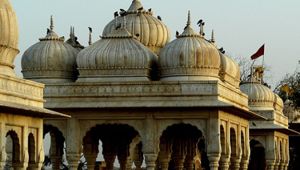 Devi-kund, the Royal crematorium, is a world class example of architectural marvels of Historical India. Devi-kund is the site of royal cenotaphs (called Chattri in the local language) of the Bikaji Rathores, the great rulers of the Bika dynasty. Reflecting the Rajputana architectural style, the Devi-kund chattris steal the hearts of tourists.
There are several chattris, one each for one Bika ruler constructed at the exact spot where he was cremated. The crematorium for royal adult men are white structures canopied with an upright stela engraved their name, portrait and. Those for royal wives are canopied structure covering a horizontal plaque with a pair of footprints often marked with the kind of henna patterns drawn on the feet for a wedding or festival. And those for children are small white cubes are not canopied. |
|
Gajner Wildlife Sanctuary |
Top^ |
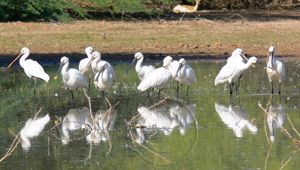 The Gajner wildlife Sanctuary is located at a distance of 32 kms. from the town of Bikaner. In the days of yore Gajner Wildlife Sanctuary used to be royal hunting grounds of the Maharaja of Bikaner. There is a sparkling lake inside the sanctuary and in the sweltering summer months one can see a variety of wild animals that come to the lake to quench their thirst. The Gajner wildlife Sanctuary is located at a distance of 32 kms. from the town of Bikaner. In the days of yore Gajner Wildlife Sanctuary used to be royal hunting grounds of the Maharaja of Bikaner. There is a sparkling lake inside the sanctuary and in the sweltering summer months one can see a variety of wild animals that come to the lake to quench their thirst.The Gajner Wildlife Sanctuary is home to a number of wild animals and some of the resident species include wildfowls, deer, antelope, nilgai, chinkara, black buck, desert foxes and wild boars to name just a few. |
|
The Camel Breeding Farm |
Top^ |
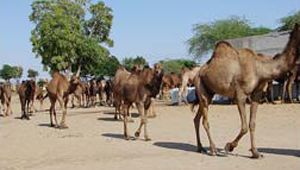 Bikaner-Camel Breeding Farm is one of the most preferred tours from Bikaner. The Camel Breeding Farm of Bikaner was founded by the Indian Council of Agricultural Research on July 1984. The Camel Breeding Farm is one of the largest camel farms of Asia and is located at Jorbeer, Bikaner. Bikaner-Camel Breeding Farm is one of the most preferred tours from Bikaner. The Camel Breeding Farm of Bikaner was founded by the Indian Council of Agricultural Research on July 1984. The Camel Breeding Farm is one of the largest camel farms of Asia and is located at Jorbeer, Bikaner. The Camel Breeding Farm of Bikaner, popularly known as Government Camel Breeding Farm, breeds the finest of camels in Bikaner. The Bikaner Camel Breeding Farm also conducts researches and experiments on the camels. The results obtained from the experiments are used to promote camel breeding. The Camel Breeding Farm in Bikaner employs the 'Raikas' or 'Rebars', local camel breeders, and aims towards making camel economically advantageous for the camel rearer of Bikaner. |
|
Kolyatji |
Top^ |
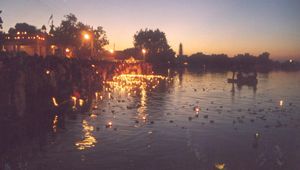 It is located 50 kilometres from Bikaner. It is a temple complex of Kolyat and a holy place of pilgrimage for Hindus. The legend has it that Kapil Muni the advocate of Shankya yoga of the Hindu philosophy while journeying towards northwest was struck by the tranquility and peace of this place and chose to perform tapasya (penance) here for the redemption of the world. This place has since acquired great sanctity. The complex has several temples, pavilions and bathing ghats. A dip in the holy waters of the lake especially on Kartik Poornima (November) is considered very auspicious. It is located 50 kilometres from Bikaner. It is a temple complex of Kolyat and a holy place of pilgrimage for Hindus. The legend has it that Kapil Muni the advocate of Shankya yoga of the Hindu philosophy while journeying towards northwest was struck by the tranquility and peace of this place and chose to perform tapasya (penance) here for the redemption of the world. This place has since acquired great sanctity. The complex has several temples, pavilions and bathing ghats. A dip in the holy waters of the lake especially on Kartik Poornima (November) is considered very auspicious.
|
|